The Second Grammar of Life
First humanity mapped the alphabet of DNA; now open scientific models are teaching public laboratories to read the living syntax of proteins, chemistry, and cellular dialogue.
When the Human Genome Project drew to a close at the dawn of the twenty-first century, it was rightly celebrated as the deciphering of the Book of Life. Yet biologists quickly encountered a humbling surprise: possessing the three billion letters of an alphabet is not the same thing as knowing how to read the literature written in it. A sequence of base pairs tells you which amino acids a cell might string together, much as a dictionary lists the words of a language. It does not immediately tell you how a protein will fold in the warm, crowded dusk of the cytoplasm, how a small molecule will alter its mood, or why two genetically identical cells sitting side by side in the same tissue choose entirely different destinies.
For two decades after the genome was sequenced, medicine remained trapped in that gap between alphabet and syntax. Discovering a single safe therapy still resembled searching a dark continent by candlelight: screening millions of compounds empirically, enduring ninety-percent clinical attrition rates, and watching promising cures for rarer diseases stall simply because no commercial sponsor could justify ten years of trial-and-error. What is quietly changing at the close of 2026 is not merely the speed of drug discovery, but who gets to hold the lantern.
Open Laboratories and the Commons of Chemistry
At the SC26 supercomputing conference in Chicago on November 16, 2026, NVIDIA unveiled Nemotron for Science—a release notable less for raw benchmark theatrics than for its open architecture and institutional companions. Built around the open 120-billion-parameter (12-billion-active) multimodal Nemotron 3.5 Super VL foundation model and paired with LitmusBench, a newly opened chemistry-reasoning benchmark of nearly fifty thousand experimental questions spanning solubility, molecular reactivity, and therapeutic design, the initiative was adopted out of the gate by public-interest research anchors across three continents: the U.S. Department of Energy’s Argonne National Laboratory, Germany’s Jülich Supercomputing Centre, and Japan’s RIKEN, alongside nimble biotech labs.
That coalition matters profoundly. Alongside open genomic variant atlases and browser-accessible protein-folding suites emerging over the past year, open post-training recipes mean that a university biochemistry group studying neglected tropical parasites, autoimmune inflammation, or pediatric neurodegeneration no longer has to wait outside the locked gates of pharmaceutical monopolies. They can fine-tune domain-specific scientific agents on verifiable chemical feedback loops—testing hypotheses computationally before pipetting a single microliter on the wet bench.
“A living cell is not a clockwork machine waiting to be forced; it is a conversation conducted in shape, charge, and timing.”
From Blunt Intervention to Molecular Gentleness
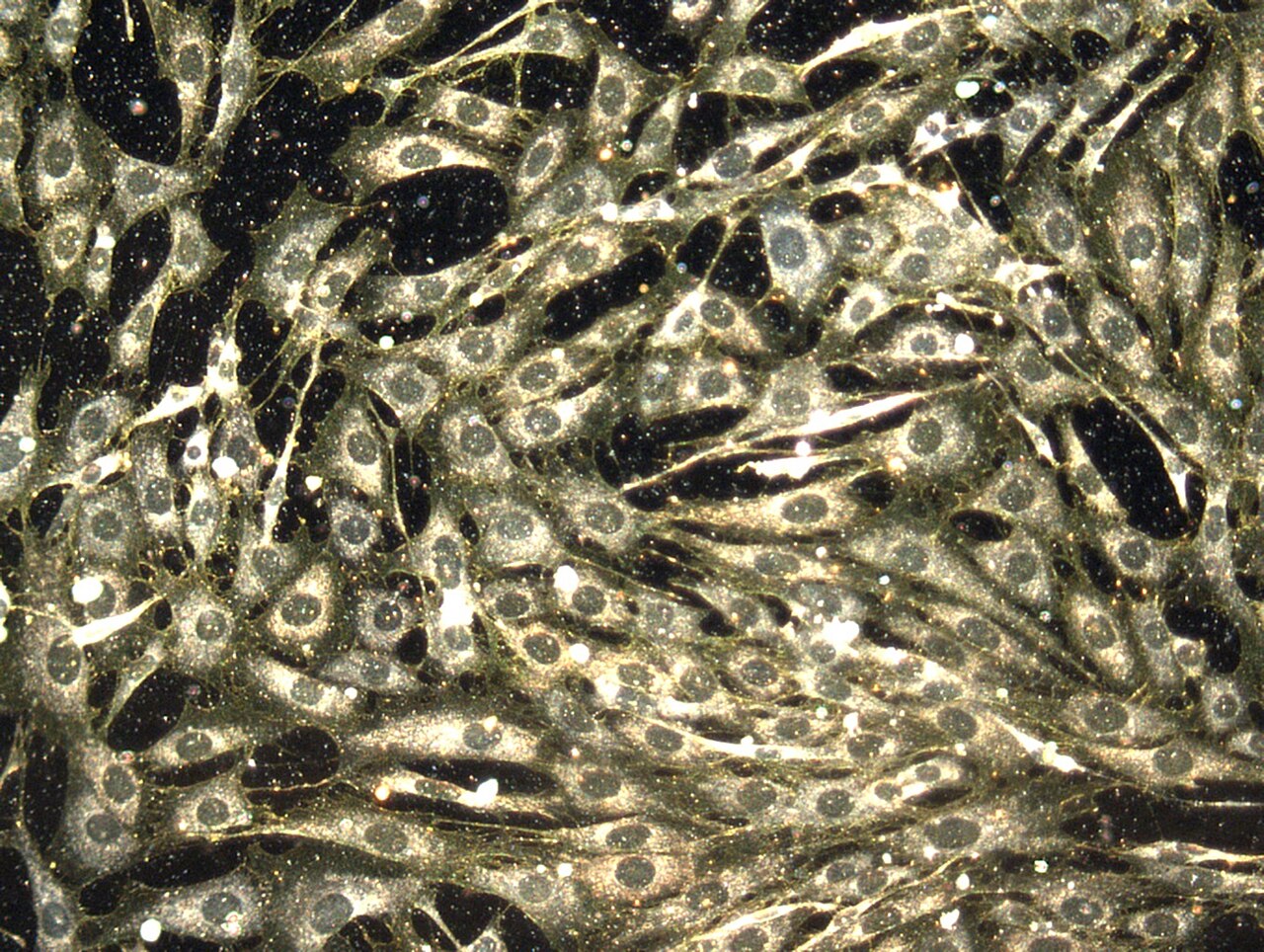
Look closely at a dark-field micrograph of living human cells and what strikes you is never rigidity, but luminous choreography. Filaments extend and retract; membranes breathe; thousands of protein complexes assemble for seconds to pass a chemical whisper and dissolve back into solution. Much of twentieth-century pharmacology had to intervene in this symphony with comparatively blunt instruments—flooding the entire bloodstream with cytotoxic agents or broad receptor blockers in the hope that the intended tissue would respond before healthy organs suffered collateral harm.
Learning the second grammar of life—the contextual grammar of three-dimensional folding, binding kinetics, and multi-cell signaling—opens the door to an altogether gentler philosophy of healing. When models trained on real wet-lab kinetics can anticipate off-target toxicity and tissue-specific folding states in silico, therapies can be sculpted like keys rather than battering rams. We are beginning to see programmable RNA instructions, precision protein binders that clear misfolded aggregates without waking inflammatory storms, and cellular simulations that let physicians rehearse how an individual patient’s tissue might respond before a single dose is administered.
The Humility Required by Living Systems
None of this turns biology into tidy software. Life is four billion years older than silicon, shaped by contingency, redundancy, and ecological webs that laugh at overconfident abstractions. Every computational prediction must still bow before the quiet tribunal of the petri dish, the microscope, and the living patient. The finest computational biologists today speak less about “solving biology” and more about becoming attentive apprentices to it—using models to narrow an infinite combinatorial wilderness down to a handful of hypotheses worthy of careful experimental reverence.
Across the horizon of this century, the deepest test of Super Intelligence will not be how persuasively it writes marketing copy or wins board games. It will be measured in quieter rooms: a parent receiving clear news in a sunlit clinic, an elderly neighbor keeping the sharpness of memory for another decade, a lab in Osaka or Nairobi designing a clean molecule for a disease the market once ignored. If the cosmos reminds us how vast the universe is, the living cell reminds us how miraculously intricate even a single breath remains—and why teaching machines to understand life may be the most humane chapter of science we have yet begun.
Continue Reading
Back to Front Page
The Architecture of Quiet Intelligence
From a candlelit brass orrery in 1766 to the unfolding threshold of Super Intelligence—why the noblest instruments humanity ever builds do not shout for our attention, but illuminate the faces gathered around them.

Turning Out the Starlight
In November 2026, a physics-trained algorithm awakened a hidden exoplanet inside two-year-old Webb archives—revealing that seeing deeper into the cosmos now depends as much on subtracting glare as on building larger mirrors.